Tuesday, 30 September 2014

Quilt for September


I have only a few more reproduction quilts to feature on this blog. This one is half reproduction and half not quite a reproduction. The design is intentional. The small squares are reproductions, once again, mostly from tiny samples I collected over time. The borders and backing are wonderful prints that are not reproductions but work well with the various older-style prints and colours. I fell in love with them but had a hard time matching them to modern prints and so decided, instead, to blend multiple eras.


The squares measure 2 ¼” each and the quilt itself is 44” square. It is entirely hand pieced, hand quilted and hand finished. 


The first photograph is a little tilted as I had to take the picture by myself, standing on a bed and wobbling as I did so – not a method I would recommend. 


My historic knitting has been on hold as I spent part of the summer and September making a modern quilt for a young couple as a wedding gift. I hope it will be cherished and, perhaps, handed down and become a piece of the new family’s history.

Thursday, 18 September 2014

Very Pretty Turkish Purse


This long purse is now finished. The pattern is from The Lady’s Assistant for Executing Useful and Fancy Designs in Knitting, Netting and Crochet by Mrs. Jane Gaugain, To be had at I.J. Gaugain', Foreign and British Depot of Berlin Patterns and Materials for Ladies' Fancy Works, 1840.

I wrote about this purse a few months ago* but to quote again from the original pattern there should be  “six broad coloured stripes,” in plain knitting and a lace pattern in between each. The pattern suggests crimson as one of “two skeins of coloured silks” and “one of white” of “purse twist, a size finer than common twist.” I did not have silk twist and, since I am trying to use up my stash, I used DMC Coton Perle 8 in my collection’s available colours of bright red, navy and gold .  The needles should be  “two wires of No. 18,” so I used the modern equivalent of 1.25 mm/US 0000.

The purse is knit flat, horizontally, and then sewn close from either end, leaving a gap in the middle for inserting money.

There are no finishing instructions in the original pattern but these purses were often decorated with tasells or beads. They also variously had flat or gathered ends. I did one of each for this purse, adding little tassels. Small rings, which slide up or down, keep the two ends of the purse closed. The rings I have made, covered with more silk/cotton, are too large so I will have to make another pair for this purse.

The purse measures 10 ¼” in length and just over 2” in width.

Sunday, 7 September 2014

Quilt for August in September


Life has been taking too many turns in different directions recently so the August quilt post is a tad tardy.  The photos show a toile quilt in progress. The toile print is from one of RJR Fabrics’s early Smithsonian lines - the Rising Sun (1825-1835), I think.

Two panels of about 40” plus wide, respectively, were sewn together. I am not sure just how long the quilt will be but it should be large enough for a double bed. There will be no borders, just the usual knife edges.


The reverse is plain muslin with a double-cross hatching pattern (difficult to photograph.) I penciled the pattern on the muslin, using a stencil, before I tacked/basted the three layers together. The middle layer is a cotton batting/wadding. The panels were sewn by hand and is being hand-quilted and will be hand-finished.

I am ashamed to say that I started this quilt quite a few years ago. I was madly trying out all sorts of patterns, materials, techniques, tools, etc., and many, many quilts were started but not all were finished. This one is extremely heavy so I have put off the quilting until every winter, thinking I could snuggle under it as I worked on it. The double-hatching is also a very time-consuming quilting pattern. Those are all of the excuses. If the coming winter is very cold, I may just get this quilt finished in 2015, along with a few other stragglers.


Thursday, 14 August 2014

Very Pretty Pattern for a Fish Serviette


This pattern comes from Exercises in Knitting by Mrs. Cornelia Mee, London: David Bogue, Fleet Street, 1846.


I have not been able to find absolute documentation for a fish serviette but my guess is thatthis may have been placed on the table or a sideboard for serving, over the tablecloth to protect it, and under or next to the serving dish so as to catch any dripping, sauce or fragments of food as it was served or transferred onto the plate for eating.  Might it also have been an elegant cloth, held under the platter by a servant to catch any dripping, as he or she offered it to those sitting at the table – a scene constantly portrayed on Downton Abbey. I must look closer at the serving dishes next time I watch it. Did the stately homes, or even modest ones belonging to the 19th century rising middle class with their fish forks and knives, have many of these serviettes? They may seem like yet more pieces of excessive and pretentious 19th century household paraphernalia or just another pattern in a publication but, on the other hand, they would help keep the tablecloth clean throughout the meal and a piece of cooked fish does have a tendency to fall apart. The serviette itself, for all of its delicate stitches is actually rather dense and would be absorbent for those bits or sauce that might fall or to wipe the edges of the serving dish, and then disappear after the fish course of the meal.


The fish serviette was knit on 2.25mm/US 1 with DMC Baroque Crochet Cotton, Size 10
The twelve row pattern should be repeated for a length of  of about “9 or 10 nails” (roughly 22 ½”) but mine is only 13 ¼” long by 10 ¼” wide.


The serviette should be laid lengthways in front of the serving dish or platter. 

Thursday, 31 July 2014

Quilt for July


This quilt is not a reproduction one in terms of the prints. It does, however, use an old pattern which I found in an American library book. I was very careless when I made this quilt as I did not write down the name of the book some fifteen or so years ago during construction. I do not have, therefore, the source or the name of the pattern. I also used to have a very large collection of books about quilting but I never found a quilt with this pattern. I don't know what it is but on the other hand, the book it came from was, as I seem to remember, probably from the 1960s-1970s with black and white photographs, and might have had more of a romantic than a factual lean to it. The upshot is that I would love to have a name for this pattern as it is dramatic potential and quick and easy to stitch. 

As for the materials in this quilt, I only had a little bit of the deep purple and the yellow chintz but I liked them together. The blocks were pieced but sat around for a few years before I found an interesting contrasting print, the blue floral one, which is also the backing. I do, however, hope to make this quilt again with reproduction prints.

The quilt is 29" square and the blocks measure 6" square each, and is entirely hand pieced and hand quilted.

Tuesday, 22 July 2014

Long Purse from The Lady’s Assistant


This pattern, knit in red, navy and gold, is A Very Pretty Turkish Purse from The Lady’s Assistant for Executing Useful and Fancy Designs in Knitting, Netting and Crochet by Mrs. Jane Gaugain, To be had at I.J. Gaugain', Foreign and British Depot of Berlin Patterns and Materials for Ladies' Fancy Works, 1840.

The pattern calls for “six broad coloured stripes,” in this case suggesting crimson, green and white “purse twist, a size finer than common twist.” I do not have silk twist and, since I am trying to use up my stash, I am using DMC Coton Perle 8 in my collection’s available colours.  The needles are  “two wires of No. 18,” the modern equivalent being 1.25 mm/US 0000.


At same time, I am also working on an adapted version from Wicked Woolens.* This purse is knit with larger needles and thicker thread or fine wool and fewer stitches on 2 mm/US O needles.  For this one, I have chosen DMC Cébélia 10 cotton in green, pink and white – another stash buster decision.


Both are easy to knit and make good lunchtime projects at work when there is a lot of distraction about, and the tin is a safe and useful way to transport both purses with their delicate needles and multiple cotton yarns. 


Monday, 14 July 2014

Bastille Day – Knitting in 18th Century France


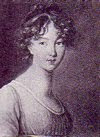
Portrait of Marie-Thérèse Charlotte, “Madame Royale”
Adolf Ulrik Wertmüller
(1751-1811)
Swedish
1786
Oil on canvas
Löfstad/Lövstad Castle


July 14th is the French national day and always brings to my mind the most famous knitter in literature, Charles Dickens’s Madame Defarge from his A Tale of Two Cities. Each year I dutifully take down my red leather covered  Centennial Edition, published by Heron Books, purchased for me serially with all of Dickens’s other works, which were covered with green leather, and open it at the always ribboned bookmarked page with Phiz’s illustration* from  Chapter V, The Wine Shop.

There is, however, another person, a young girl, whom I remember each year on this day. She is Marie-Thérèse Charlotte, Madame Royale, the daughter of Louis XVI and Marie Antoinette, later the Duchesse du Angoulême (1778-1851.)  I started collecting books about her after doing intense research some decades ago about the French Revolution. The books currently number five, and I am continually on the trail of others.


Louis-Charles and Marie-Therese Charlotte
Ludwig Guttenbrunn
(1750-1819)
Austrian
1788
Fondazione Palazzo Coronini Cronberg, Gorizia (?)


Within her heartbreaking story of survival, I have consistently run across references to her knitting during her captivity.  In the course of also reading many books about Marie Antoinette, I have found mention of the Queen knitting, doing tapestry work and generic needlework. I even remember seeing an auction notice a few years ago that was for knitting needles that purportedly belonged to Marie Antoinette. Tracking down that auction has been on my To Do List ever since.


There is every likelihood that the young Marie-Thérèse would have learned various kinds of needlework from the women about her, both familial and instructional. It is in the accounts of her imprisonment in The Temple that I find the references to her knitting.

In Marie-Thérèse’s own version of the royal family’s time spent in captivity, she writes that after her mother was removed from her and her aunt, Madame Élisabeth, Marie Antoinette,

“…in order to get some news of us, tried to send for some necessary articles, among others her knitting, for she had begun a pair of stockings for my brother. We sent it, together with all we could find of silks and wools, for we knew how she liked to be busy; she had a habit in former days of always being at work, except in her hours of public appearance. In this way, she had covered a vast quantity of furniture and had even made a carpet and a great deal of coarse-wool knitting of all kinds. We therefore collected all we could; but we learned afterwards that nothing had been given to her, fearing, they said, that she might do herself a harm with the knitting-needles.” (1)


The Royal Family of France in the Temple
Edward Matthew Ward
(1815-1879)
English
Oil on canvas
19th Century
Magdalen College, Oxford


Later in the narrative, Marie-Thérèse wrote how “…they took away from us the pieces of tapestry which she {Marie Antoinette} had worked, and those on which we were then working, under the pretext that there might be mysterious signs in that tapestry and a peculiar kind of writing.”(2) Sounds familiar?

After her aunt was taken away, the horrendous treatment of Marie-Thérèse continued. She had little light and few books which she had read over and over again. She was allowed her knitting but she wrote “…that ennuyéd me very much.”(3) G. Lenotre claims “Madame Elisabeth had accustomed her to occupy her time in this way.”(4)

In a memoir dated November 3, 1851, the literary critic, Charles Augustin Sainte-Beuve wrote “One of the commissioners whose duty it was to visit the young princess in the Temple, has left a representation of her in her seemly attitude, suffering and poverty-stricken, seated by the window knitting, and far from the fire (there was not light enough for her work near the chimney), her hands swollen with cold and covered with chilblains, for they did not giver her wood enough to warm the room at any distance.”(5) A full account of this visit, by Jean-Baptist Harmand de la Meuse, states “Madame knitted with difficulty and with an air of obvious discomfort.”(6) Yet she kept knitting, perhaps to help preserve her sanity.

By 1795, the continual abusive treatment seems slightly ameliorated according to the accounts of the steward in which are listed “…for the girl Capet…” new items of outer and under clothing (at long last), and “…thread, knitting-needles and pomade…”(7)

The young Marie-Thérèse is, however, a frustrating figure to research as it is difficult to judge the reliability of contemporary or later sympathetic, sometimes romantic or conflicting sources. Even her own account passed through several hands so should its veracity be questioned? None of this is surprising considering the turmoil and horror of the times and the passage of memory. I am naturally suspicious or cautious as a professional researcher, working in the fields of history and literature but that does not stop me from thinking that she may have been knitting as described. Furthermore, I wonder if she ever picked up knitting needles and wool or silk again, after her release in December, 1795 or in her later life as would the memory and association have been too painful?


Portrait of Maria Theresa Charlotte of Bourbon
Heinrich Füger
(1751-1818)
German
After 1795
Oil on canvas
The State Hermitage Museum


(1) The Ruin of a Princess as Told by The Duchesse du Angoulême, Madame Elizabeth, Sister of Louis XVI, and Cléry, the King’s Valet de Chambre. Translated by Katharine Prescott Wormeley. New York: The Lamb Publishing Co., 1912. Narrative of Madame Royale, p. 270
(2) Ibid, p. 271
(3) Ibid, p. 285
(4) G. Lenotre (Louis Léon Théodore Gosselin), The Daughter of Louis XVI, Marie-Thérèse-Charlotte de France, Duchesse d'Angoulême. Translated by J. Lewis May. London: Lane, 1908, p.9
(5) Wormeley, p. 303
(6) Lenotre, p. 29