Saturday, 26 June 2010

Red Under Petticoat Update


The Red Under Petticoat is growing. I will do a thorough discussion of it when it is finished but for now I have to say that it has been fun to knit. The puckered lower edge is created by extended slipped stitches. Once I was past the lower edge, this became my World Cup knitting as I only need to keep count of the stocking stitch rows and not really look at them as I knit.

Unlike England's Flag Flying*, designed by Erssie Major, which required more attention. I worked on it as fast as I could but didn't have it quite ready for the first match! I knit this on 2.25mm/US 1 needles with DMC Six Strand Embroidery Floss in the Portrait version of the pattern. The finished piece measures 5 1/2" wide and 3 3/4" down, not counting the garter stitch edge I added. The gauge/tension is 12 stitches to one inch.

*Free pattern at http://erssieknits.squarespace.com/

Tuesday, 8 June 2010

Worldwide Knit in Public Day/Week


An Outdoor Literary Salon
French School, early 19th Century
Private Collection
The Bridgeman Art Library
Creative Image #79108854


Saturday, June 12th, kicks off this year’s celebrations of Worldwide Knit in Public which have been extended from one day to a full week! Seize upon your latest project, wips or start something new, and dash outside as often as possible over the coming days! Follow the example of the lady in the lower left corner of this image who calmly wields her needles in the midst of a volatile literary discussion. As usual in this genre, there is a great deal happening and even more being implied in the image but I am, for this post, just interested in the knitting although happy to have an illustration from one of my favourite eras in history. The industrious lady seems to have ony two needles in action – is she knitting something flat and, if so, what? A comforter, part of a shirt? Or is that the beginning of a stocking on four or more needles and we cannot see the others? There seems to be several strands of yarn hanging down from her work but she is only knitting in one colour. Could these strands and the fact that she does not seem to be holding her knitting in a very capable way suggest that her knitting skills are as pretentious or limited as the literary ones of those of her fellow members of the society? Or is this yet another example of an artist being unfamiliar with knitting, its tools and its hand positions? At any rate, the picture is bright and funny, and there is a knitter in it so I cannot really complain!

Sunday, 23 May 2010

Lady's Knitted Under Petticoat


This pattern comes from Godey’s Lady’s Book, December, 1864, page 533, with no suggested needle size or gauge and calling for “four-thread scarlet fleecy” and the same in white; its modern equivalent is lace-weight. It is easy and fun to knit, and very hard to put down which is good as it calls for several long panels that will then joined with a “single crochet.” I am knitting it on 3mm needles, in Nature Spun Sport weight 100% wool (Scarlet and Snow.) I did try it first in lace weight wool on both 3mm and 3.50mm needles but the result, with my tension, was too airy and loose.

The photograph shows the beginning of the border hem of a panel.

Saturday, 24 April 2010

The Brewster Stocking


The Brewster Stocking by Jacqueline Fee was featured in the magazine Piecework, January/February, 2010. The pattern for her modern adaptation of the spiral stocking is available by request, from Jacqueline Fee, and is not the sock pattern that appears in the issue of the magazine. It is based on a stocking owned by Pilgrim Hall Museum, Plymouth, Massachusetts and is dated from the 17th century. The article and the photograph of the original stocking stirred up debate on several electronic forums devoted to historical knitting with questions raised as to its dating and previously documented use of the spiral pattern on stockings in the 17th, 18th and 19th centuries. No one, unfortunately, including me, could immediately produce a photograph of or pattern for a spiral stocking although I seem to remember seeing a photograph of such a stocking on a museum website in the past few years. The relative shapelessness of the stocking also gave rise to comments and speculation as to the skills of the original knitter and the owner, believed to have been “William Brewster (1567-1644) of the Plymouth Colony,"* his leg and his health, gout being one of the suggestions due to the width of the leg and shape of the foot.

Since this was an adaptation of a period object, I decided to follow the pattern exactly and not make any changes. The heel flap had been modernized from the traditional long square one of the original stocking but the spiral patterns had been left in the new design much as they had appeared in the original. There is also no seam stitch although there appears to be one in the original stocking, based on the photograph in the article. Ms. Fee has been very helpful since the publication of the article, according to those on the net who have shared their questions and her responses. The pattern was worked from notes and a sketch she did some twenty years ago.

The top of the original stocking also intrigues me. It appears to have two rows of welting that may have been folded over from the inside over to the outside, visible thanks to the part that has rotted or torn or been eaten away. The original stocking had a tension/gauge of 11-13 to the inch and was knit in wool. The size of the needles could only be determined by matching gauge with a similar weight of yarn.

My finished measurements came out a tad different than the pattern suggested ones in spite of swatching. My adapted version is 12 inches in width at the leg, 12 inches around the foot at its widest at the base of the heel, its length measuring 11 inches and the stocking, itself, 10 inches around the garter stitch section near the toe and 25 inches from top to heel. The adapted pattern calls for 2.75mm/2US needles using Bartlett Sport Weight 2 ply-wool to get a tension/gauge of 7 stitches to the inch. In keeping with my oath to stash bust, I swatched with a nameless laceweight, Blackberry Ridge laceweight, Brown Sheep Nature Spun laceweight, and, finally and successfully, Harrisville Design’s New England Shetland (394 yards per skein) in Russet. The stocking used two skeins with just a yard or so left over.

The leg looks wide and unshaped but there is some decreasing. The spiral pattern does not work out evenly round and round the stocking but the difference is minimal and easily adjusted as one knits. I tried to stay true to the pattern (unusual for me) but gave in at the toe which is supposed to be grafted. I simply do not like grafting and do not do it well so I made a drawstring toe.


The spiral pattern does not, unfortunately, really come across that sharply in the photographs. It is easier to appreciate the rippled effect it creates on the sides. Click on the photographs for a larger image.


The stocking was fun to work on, partly because of the spirals and partly because I didn’t have to write the pattern! I decided to make only the one stocking as no one will wear it because of the shape. This modern version was also a dry run in case I want to go back and make a more historically accurate version of the original stocking with more shaping in the leg, a period heel and seam stitch. Knitting with Harrisville Designs Shetland was terrific, too – I adore that wool!

* Fee, Jacqueline. The Brewster Stocking. Piecework, January/February 2010, p. 29

Sunday, 4 April 2010

Knitting Before and Behind the Camera

I mentioned my fondness for old films some time ago here, and named Bette Davis as one of my favourite actresses. Apart from all of the legendary lines she delivered and her place in film history (not only as an actress), she was a keen knitter. April 5 would have been, her 102nd birthday so I would like to feature her in different photos that I have studied for information about knitting in her lifetime. There is a tad of knitting history if we look at her knitting bags such as the one on her lap in the photo of her in sunglasses on the set of, I am guessing, The Old Maid. I also always try to get a good look at her needles in the films where we do see her knitting.


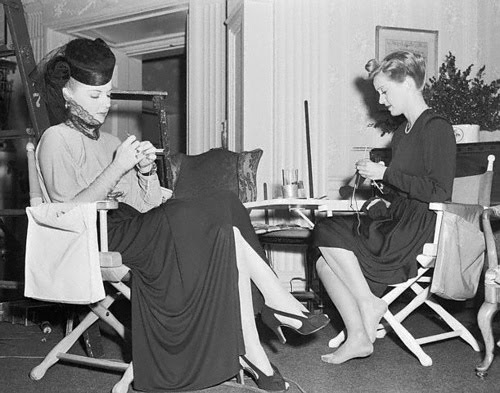
Here she is knitting off-camera with co-star Ann Sheridan (who appears to be crocheting) on the set of The Man Who Came to Dinner.


I haven’t watched Now Voyager for some time but I do seem to remember an early pivotal knitting scene as well as knitting while cruising later on in the film.


She also knit in Phone Call From a Stranger.


Look at the knitting container (case/bag/cylinder – what was this called?) next to her as she works on a contribution for the Red Cross during World War II. If she was knitting in between takes in this photograph, I have yet to identify the film.


Bette Davis’s most famous filmed handwork, though, must be the crocheted lace she worked on throughout the film, The Letter. She is seen here, crocheting on that set, alongside her stand-in, Sally Sage, who is knitting an Argyle sock. I wish we could see their work bag and basket more clearly.


Davis’s character’s crocheting and her supposed finished work are again, important elements in the film. I just wish, too, in this one of my favourite films, let alone favourite films of Bette Davis, that her character had, instead, been knitting lace!


Credits: Images from The Old Maid, Now Voyager, The Man Who Came to Dinner and The Letter owned by Bettman/Corbis? They can all be found on various Flickr accounts.

Image from Phone Call From a Stranger is from The Complete Films of Bette Davis by Gene Ringold, New York: Citadel Press, Inc. (1985, 1990), page 157.

Tuesday, 30 March 2010

2010 Knitting Resolutions


It is almost April and I have not reconciled last year’s list of knitting resolutions, let alone drawn up the 2010 list on paper although the list, such as it is, continually grows by leaps and bounds in my mind.

I listed fourteen wips last year (http://historyknits.blogspot.com/search?q=resolutions) and completed the 19th century garters* (one only as I ran out of DMC yarn and I cannot find exact colour matches for it now), the child’s handspun and marled stockings, the handspun gloves, the 1855 mitts and the Vanity Fair purse. Six out of fourteen projects is not terribly respectable but added to the projected and unexpected items, the numbers do go up. Not just one but three 19th century under or half caps were made (although none of them completely satisfactory) and the man’s 19th century nightcap became a boy’s. The projects that did work out well were the Gunnister purse*, long 18th century woolen mitts*, another 19th century miser’s purse, the 17th century red and blue mini-stockings, Stephen Maturin’s blue mini-stockings, the Norwegian morning cap/hood, two different pairs of 19th century undersleeves and a linen bookmark in lace from the 1830s-1840s. The clamshell coverlet continues to grow in clamshells and I think I have found a filler section pattern for the edges. Not content with knitting masses of pieces for one coverlet, I started an octagon/squares one*, too. Tiny 19th century lace samples* needed a place for display so I created an album* out of 19th century reproduction fabric to house them. And then there was that 19th century lace fish serviette* that I just couldn’t resist starting just to see what the pattern looked like, of course.

The Garment is not languishing but still very much nearly finished. More on that soon. Contemporary projects and various commissions usually take precedence over the historical knitting and the historical knitting creates delays of its own. I am very lucky if the first version becomes the final version. I sometimes knit a miniature version just to work out the pattern, especially if I am knitting blind, that is, from one of those delightfully laconic, illustration-free early patterns or trying to reproduce a surviving item, or will knit several “life-size” versions before the final one, if there is a final one, works out. The half-caps were a case in point and I am still not satisfied with the wool and am working on a fourth one that I hope will be more historically accurate.

On the 2010 list are, of course, the uncompleted 2009 projects as well as the following:

1. Gunnister gloves
2. Blue mini-Maturin comforter (half completed)
3. Another Weldon’s nightcap (which I am re-knitting for the fourth time as I write this)
4. 19th century lace collars
5. Second pair of long 18th century woolen mitts (one finished, one to go)
6. 19th century knitted veil
7. 19th century double-knitted wristlets
8 Mid-19th century under-cap
9. Sortie cap
10. A muff or two
11. 1855 mitts in white and pale blue
12. 19th century pen wiper (that I have twisted my brain into knots over twice already)
13. 19th century knitted petticoat

and because I like a challenge, this 18th century pincushion* whose own work box with materials is in the above photo. It is cast on but I can only do one row a day or so as the work is very, very fine and hard on the hands as well as the eyes, not to mention the charting of the pattern on paper (more on this project soon):

http://www.vam.ac.uk/collections/fashion/features/knitting/objects/object.php?id=31&id2=0&action=&hits=&page=&pages=&object_type=&country=&start_year=&end_year=&object=&artist=&maker=


I daresay there will be another miser's purse this year, too, as I just cannot resist them.


*Items marked with an asterisk will appear soon on the blog.

Thursday, 18 March 2010

Knitting and Walking


Knitting in the Fields
Charles Sprague Pearce
(American, 1851-1914)
Private Collection

This is me yesterday. The weather is improving and I can take my gloves off outdoors and knit as I walk. Although this painting is called "Knitting in the Fields," the subject may be walking along a small river. I did the same for about two hours yesterday though by a much larger river (and on a smoother surface) in the first, fine sunny and warm yet breezy day this year. I was also working on a long piece, an 18th century long mitt, adapting it to fit me, and so ripping and re-knitting the thumb and upper hand as I went along, any frustration dispelled by the glorious weather, the breeze in my hair and wool, and the sheer delight of knitting outside in pure daylight and fresh air.

The weather in this painting does not look as nice as mine, and the knitter seems to warding off the chill with her outer clothing. She may, also, not be walking but standing as the leg in front is bent and the other is straight. Has she stopped because something we cannot see has caught her attention or is she simply pausing? Her hands have stopped knitting, too, and there is no strand of wool attached to her work. Has she run out of wool and so the stocking production has also halted?

We do see, for once, FOUR knitting needles - huzzah!