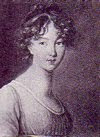
Portrait of Marie-Thérèse
Charlotte, “Madame Royale”
Adolf Ulrik Wertmüller
(1751-1811)
Swedish
1786
Oil on canvas
Löfstad/Lövstad Castle
July 14th is the
French national day and always brings to my mind the most famous knitter in
literature, Charles Dickens’s Madame Defarge from his A Tale of Two Cities. Each year I dutifully take down my red leather
covered Centennial Edition,
published by Heron Books, purchased for me serially with all of Dickens’s other
works, which were covered with green leather, and open it at the always
ribboned bookmarked page with Phiz’s illustration* from Chapter V, The Wine Shop.
There is, however, another
person, a young girl, whom I remember each year on this day. She is
Marie-Thérèse Charlotte, Madame Royale, the daughter of Louis XVI and Marie
Antoinette, later the Duchesse du Angoulême (1778-1851.) I started collecting books about her
after doing intense research some decades ago about the French Revolution. The
books currently number five, and I am continually on the trail of others.
Louis-Charles
and Marie-Therese Charlotte
Ludwig
Guttenbrunn
(1750-1819)
Austrian
1788
Fondazione
Palazzo Coronini Cronberg, Gorizia (?)
Within her heartbreaking
story of survival, I have consistently run across references to her knitting
during her captivity. In the course
of also reading many books about Marie Antoinette, I have found mention of the
Queen knitting, doing tapestry work and generic needlework. I even remember
seeing an auction notice a few years ago that was for knitting needles that
purportedly belonged to Marie Antoinette. Tracking down that auction has been on
my To Do List ever since.
There is every likelihood
that the young Marie-Thérèse would have learned various kinds of needlework
from the women about her, both familial and instructional. It is in the
accounts of her imprisonment in The Temple that I find the references to her
knitting.
In Marie-Thérèse’s own
version of the royal family’s time spent in captivity, she writes that after
her mother was removed from her and her aunt, Madame Élisabeth, Marie
Antoinette,
“…in order to get some news
of us, tried to send for some necessary articles, among others her knitting,
for she had begun a pair of stockings for my brother. We sent it, together with
all we could find of silks and wools, for we knew how she liked to be busy; she
had a habit in former days of always being at work, except in her hours of
public appearance. In this way, she had covered a vast quantity of furniture
and had even made a carpet and a great deal of coarse-wool knitting of all
kinds. We therefore collected all we could; but we learned afterwards that
nothing had been given to her, fearing, they said, that she might do herself a
harm with the knitting-needles.” (1)
The Royal Family of France in
the Temple
Edward Matthew Ward
(1815-1879)
English
Oil on canvas
19th Century
Magdalen College, Oxford
Later in the narrative,
Marie-Thérèse wrote how “…they took away from us the pieces of tapestry which
she {Marie Antoinette} had worked, and those on which we were then working,
under the pretext that there might be mysterious signs in that tapestry and a
peculiar kind of writing.”(2) Sounds familiar?
After her aunt was taken
away, the horrendous treatment of Marie-Thérèse continued. She had little light
and few books which she had read over and over again. She was allowed her
knitting but she wrote “…that ennuyéd me very much.”(3) G. Lenotre claims “Madame
Elisabeth had accustomed her to occupy her time in this way.”(4)
In a memoir dated November 3,
1851, the literary critic, Charles Augustin Sainte-Beuve wrote “One of the
commissioners whose duty it was to visit the young princess in the Temple, has
left a representation of her in her seemly attitude, suffering and
poverty-stricken, seated by the window knitting, and far from the fire (there
was not light enough for her work near the chimney), her hands swollen with
cold and covered with chilblains, for they did not giver her wood enough to
warm the room at any distance.”(5) A full account of this visit, by Jean-Baptist
Harmand de la Meuse, states “Madame knitted with difficulty and with an air of
obvious discomfort.”(6) Yet she kept knitting, perhaps to help preserve her
sanity.
By 1795, the continual
abusive treatment seems slightly ameliorated according to the
accounts of the steward in which are listed “…for the girl Capet…” new items of
outer and under clothing (at long last), and “…thread, knitting-needles and
pomade…”(7)
The young Marie-Thérèse is,
however, a frustrating figure to research as it is difficult to judge the
reliability of contemporary or later sympathetic, sometimes romantic or
conflicting sources. Even her own account passed through several hands so
should its veracity be questioned? None of this is surprising considering the
turmoil and horror of the times and the passage of memory. I am naturally
suspicious or cautious as a professional researcher, working in the fields of
history and literature but that does not stop me from thinking that she may
have been knitting as described. Furthermore, I wonder if she ever picked up
knitting needles and wool or silk again, after her release in December, 1795 or
in her later life as would the memory and association have been too painful?
Portrait of
Maria Theresa Charlotte of Bourbon
Heinrich Füger
(1751-1818)
German
After 1795
Oil on canvas
The State Hermitage Museum
(1) The Ruin of a Princess as
Told by The Duchesse du Angoulême, Madame Elizabeth, Sister of Louis XVI, and
Cléry, the King’s Valet de Chambre. Translated by Katharine Prescott Wormeley.
New York: The Lamb Publishing Co., 1912. Narrative of Madame Royale, p. 270
(2) Ibid, p. 271
(3) Ibid, p. 285
(4) G. Lenotre (Louis Léon
Théodore Gosselin), The Daughter of Louis XVI, Marie-Thérèse-Charlotte de
France, Duchesse d'Angoulême. Translated by J. Lewis May. London: Lane, 1908,
p.9
(5) Wormeley, p. 303
(6) Lenotre, p. 29