Thursday, 24 September 2009

18th Century French Knitting


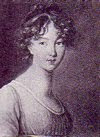
Madame Lepage
Dominque (Guillaume Dominque Jacques) Doncre (1743-1820)
(French, 1797)
Oil on canvas; 91 x 77 cm
(867.2.1)
Musee des Beaux-Arts, Arras, France

I have mixed reactions to this painting. I like it very much because it dates from one of my favourite decades in history and of clothing, and it contains knitting with visible needles. What I do not like about it is the fairly flat quality of the furniture and hangings. They are simple, and look worn and old. The face, clothing (wonderful pleating on the bodice) and the knitting have been addressed but like the partially knit stocking, the painting seems unfinished to me. Like many paintings of knitters, the subject appears to have been interrupted in her work but her expression is calm, almost contemplative, as if she has put her knitting aside for a few moments and is now holding a pose or turning her face a certain way for the painter. She does not look annoyed as does the serving girl in another one of my favourite knitting paintings:

http://historyknits.blogspot.com/2008/03/knitting-in-art.html

I have tried to find out who Madame Lepage was but without success. Did she live in Arras? Was her family or husband active in the textile business since her gown is the most vivid part of the painting? It captures the viewer’s attention at once and the eye (unless one is a knitter) travels upwards from it to the face. Her powdered hair speaks of a fading fashion but her gown is an indication of the future. Her straight-backed pose is unlike those flowing, vibrant ones of her contemporaries painted by
Elisabeth Vigée Le Brun or some of the sensuous classical poses of Jacques-Louis David’s ladies. Why did she, perhaps a lady of some social standing, choose to be painted with her knitting? Did she come from a humble background? Is this a post-Revolutionary statement that shows a person of position who is connected to the common people by doing her own knitting or did she just enjoy knitting and so wanted it to be included in her painting or is this a message that she is industrious? The ball of wool and the knitting certainly have pride of place in the painting; the garter stitch edge/welting of the stocking lies on the subject’s lap, facing the viewer and at least a third of the stocking is on the four fine metal needles which, pointing upwards and bisecting each other become a functional part of the painting, forming a V shape which is repeated above in the neckline of the gown and framed by sideways V shapes in the position of the arms on either side. The subject is ultimately set in an oval (in this image, at least; I have not seen the original) which, with the puffed up, rounded hair style and full folds of the background hangings, ultimately softens those mirror sharp angles of the sitter’s arms and gown’s neckline and the knitting needles in her lap.

I am reminded of another favourite contemporary (1791-1792) work by David:

http://www.artic.edu/aic/collections/exhibitions/Rococo/Madame

The subject in this painting wears infomal clothing, and sits sewing beside the cradle of her child, without any decorative furniture or background detail at all although this painting is considered unfinished. Unlike Madame Lepage, Madame de Pastoret barely pauses in her work and, characteristically, looks the viewer straight in the eye. How I wish the latter had been knitting or had some evidence of it included in the painting, such as an open workbox with wool and needles spilling out, perhaps, on the floor beside her.

NOTE: The link to the painting of Madame de Pastoret and Her Son is courtesy of The Art Institute of Chicago® 
by URL: www.artic.edu/aic. I also recommend reading more about the life of Madame de Pastoret.

Tuesday, 1 September 2009

Vanity Fair Purse - Finished


In my first post about the beginning of this project, there is little description of the purse in Vanity Fair that is being knit by Becky Sharp. ( http://historyknits.blogspot.com/2008/07/vanity-fair-and-history-of-knitting.html) We do not even know if she finished it after her attempts to use it to ensare Jos Sedley. I think she might have, either for something to during the next part of her story or for her own future use. Not having any money, herself, however, I am supposing that it would have been simply finished. I doubt Becky could have afforded the traditional silver closure rings so she may have used thread or hair wrapped ones. I am still researching substitute rings (bone, horn?) and in my case, I used plastic rings covered with silver embroidery thread. The ends are decorated with simple, traditional tassels of the same green thread that was used for the body of the purse.

Saturday, 29 August 2009

Lace Linen Bookmark


This bookmark, knit in Pattern Number 36 (c. 1830's) from Susanna E. Lewis's Knitting Lace, was a perfect project for experimenting with DMC's linen embroidery floss. I used three skeins on 3mm needles.

Tuesday, 25 August 2009

19th Century Undersleeves - Construction


Here are two kinds of knitted undersleeves (literally, worn under indoor clothing) from the mid-ish 19th century. Both are knitted flat or back and forth, and then sewn up.

The first photograph shows one set still in progress on HISTORICALLY INACCURATE NEEDLES but the only ones from my vast collection that gave me the correct gauge/tension. This pair, the very full sleeve ones, were improvised from the daguerreotype below, with the upper arm ribbing and bands from tighter fitting patterns I have seen and making the lower puff very large so as to show under the wide, open sleeves of the top garment or dress. This set was knit from the wrist up. The wool is Brown Sheep Nature Spun Worsted (Scarlet (2 skeins) and Silver Sage 1 skein) on 4.0/6US needles with a gauge/tension of 6.50 stitches/inch in the full part of the sleeve and 6 stitches/inch in the ribbing. The same size needles were used throughout.

The second, closer-fitting pair are from an original pattern ( Knitted Under-Sleeve by Mrs. Jane Weaver in Peterson’s Magazine, January, 1859, Volume XXXV, No. 1) which called for two sizes of needles (“1 pair steel knitting needles, common size, 1 pair bone knitting needles, small”) I had to use the larger sized needles throughout but still did not, however, achieve the puffs as shown in the original illustration, especially when wearing them (see below.) This set was knit from the upper arm down to the wrist as directed in the pattern. Brown (for the puffs) and crimson (ribbing) “single zephyr” wool was suggested in the original pattern. The wool for this pair is Morehouse Farm Merino Lace (Midnight (2 skeins) and Natural White (2 skeins) on 2.75/2US needles with a gauge of 9 stitches/inch on the puff parts and 10 stitches/inch in the ribbed parts.


Knitted Undersleeves in Daguerreotype


Unknown Baby with Hiding Mother, ca. 1855
Daguerreotype, sixth plate Plate: 3 ¼” x 2 ¾ “
Image: 2 5/8” x 2 1/8”
Gift of Hallmark Cards, Inc.
2005.27.56
Nelson-Atkins Museum of Art
Kansas City, Missouri
http://www.nelson-atkins.org/art/Exhibitions/DevGreat/CollectionDatabase.cfm?id=52548&theme=Photo


Monday, 17 August 2009

Hold Fast Gloves


This is the second pair of these gloves that I have knit. The words on the half-fingers mimic the tattoos on Joe Plaice’s fingers in the film, Master and Commander - The Far Side of the World (2003.)

I made the first pair, in the round, from the wrists up but the letters did not knit evenly. Same colour scheme and both in Brown Sheep Nature Spun Worsted. The letters were swallowed up in every other row which may have been due to their having been knit in the same kind of wool or knitting the lettered fingers flatly (the stitches came out slanted on every other row.)

This is the second pair, knit from the fingers down to the wrist (fingers and hands in the round) with fingering weight wool in an Aubrey-Maturinesque appropriate choice of “wine-dark” maroon. This wool was purchased about 30 years ago in New York and comes from my stash. The letters are knit in the heavier Nature Spun Worsted so this time they would stand out against the fingering weight.

Although the letters appear distinctly in these gloves, the S did not really knit up clearly; it looks more like an E. I did not like knitting from the fingers down (I also dislike toe up, neck and crown down knitting) as I felt as though I was swimming against the tide all of the time. In spite of all of that effort and all of the knitting going in the same direction, there is also a slight scar around each finger at the join rows to the hands.

Friday, 7 August 2009

Knitting in Art for a Summer Afternoon

Viennese Domestic Garden (1828-30), Erasmus Ritter von Engert (Austrian, 1796-1871)

Oil on canvas, 32 x 25 cm.

Nationalgalerie, Berlin

I love this painting for its light, cool summer garden and, of course, the quasi-invisible knitter tucked away in the lower left corner, working on what looks like a stocking. The overall effect is elegant as is the woman's cap and grey gown. I also like the fact that she is knitting and reading at the same time, something I enjoy doing whenever the knitting is easy enough to just follow with my fingers.